

Free Nutanix NCP-US-6.10 Study Guides Exam Questions and Answer
NCP-US-6.10 Exam Dumps, NCP-US-6.10 Practice Test Questions
NEW QUESTION # 49
An administrator needs to create a Nutanix Data Lens Report, which will be scheduled to automatically run Friday at 7:00pm. Which two formats can be used for the scheduled report? (Choose two.)
- A. JSON
- B. XML
- C. PDF
- D. CSV
Answer: C,D
Explanation:
Nutanix Data Lens provides reporting capabilities for Nutanix Files and Objects, allowing administrators to schedule reports to run automatically, such as on Fridays at 7:00pm. When scheduling a report in Data Lens, the available output formats for the scheduled report are **CSV** and **PDF**. These formats are widely supported for data analysis (CSV) and presentation/sharing (PDF), making them suitable for automated reports.
The **Nutanix Unified Storage Administration (NUSA)** course states, "Nutanix Data Lens supports scheduling reports to run automatically, with output available in CSV and PDF formats, enabling administrators to analyze and share data efficiently." CSV (Comma-Separated Values) is ideal for importing into spreadsheets or other data analysis tools, while PDF provides a formatted, human-readable document that can be easily shared with stakeholders.
The **Nutanix Certified Professional - Unified Storage (NCP-US)** study guide further elaborates that
"scheduled reports in Nutanix Data Lens can be generated in CSV and PDF formats, providing flexibility for both data analysis and reporting purposes." The administrator can configure the report in Data Lens, set the schedule for Friday at 7:00pm, and select CSV, PDF, or both as the output formats for delivery (e.g., via email or download).
The other options are incorrect:
- **JSON**: JSON is a data interchange format but is not supported as an output format for scheduled reports in Nutanix Data Lens.
- **XML**: XML is another data format but is not supported for Data Lens scheduled reports, which are limited to CSV and PDF.
The NUSA course documentation emphasizes that "Data Lens scheduled reports can be generated in CSV and PDF formats, ensuring compatibility with various use cases for data analysis and presentation." References:
- Nutanix Unified Storage Administration (NUSA) Course, Section on Nutanix Data Lens: "Scheduling reports and supported output formats."
- Nutanix Certified Professional - Unified Storage (NCP-US) Study Guide, Topic 3: Analyze and Monitor Nutanix Unified Storage, Subtopic: "Data Lens reporting capabilities."
- Nutanix Documentation (https://www.nutanix.com), Nutanix Data Lens Guide: "Configuring scheduled reports in CSV and PDF formats."
---
NEW QUESTION # 50 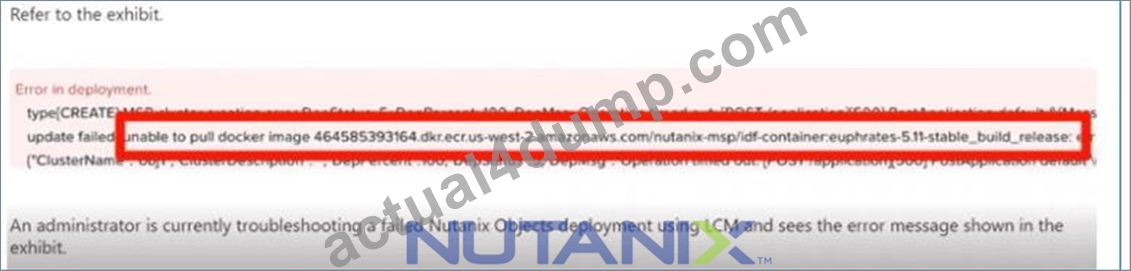
An administrator is currently troubleshooting a failed Nutanix Objects deployment using LCM and sees the error message shown in the exhibit.
The Objects cluster deployment is experiencing the following symptoms:
* The Objects Home UI Page shows the error: unable to pull the docker images
* The docker pull is failing on the first image
The administrator determined that MSP cluster deployment has completed successfully looking at msp_controller.out.
Which log file should the administrator use to investigate and troubleshoot this issue further?
- A. domain_manager.out
- B. cluster_health.out
- C. aoss_service_manager.out
- D. 1cm_metrics_uploader.out
Answer: C
Explanation:
According to the Nutanix Unified Storage Administration (NUSA) course, in theTroubleshooting Nutanix Objects Deploymentsection, the aoss_service_manager.out log file is explicitly responsible for tracking the status and lifecycle of container services, including pulling Docker images during the deployment of Nutanix Objects.
This log file is where administrators should look for:
* Container image pull attempts
* Any errors during docker pull actions
* Overall container service management actions and errors
The module"Deploying and Troubleshooting Nutanix Objects"from the NUSA course states:
"During deployment of Nutanix Objects, the aoss_service_manager.out log file provides detailed status information regarding container image pulls, container lifecycle events, and object service startup procedures.
This log file is essential when troubleshooting deployment failures related to container image downloads." The other log files listed in the question are used for different components:
* domain_manager.out:Related to domain services and identity management.
* 1cm_metrics_uploader.out:Responsible for uploading metrics, not related to container image pulls.
* cluster_health.out:Used for overall cluster health, but not specific to container lifecycle events.
Reference:
Nutanix Unified Storage Administration (NUSA) course - Module: Deploying and Troubleshooting Nutanix Objects - Section: Key Logs for Troubleshooting Nutanix Objects Deployment.
Nutanix Unified Storage (NCP-US) Study Guide - Topic: Nutanix Objects Deployment Troubleshooting.
NEW QUESTION # 51
An administrator is required to provide a summary of metrics to the Security team.
The entity information being asked for by the Security team is as follows:
* Total folders where permissions are tracked
* Size of those folders
* Total unique users
* Total unique groups
In which product and dashboard would the administrator find all the requested data?
- A. Data Lens Footprint Widget
- B. File Analytics File Operations
- C. File Analytics - Top Users
- D. Data Lens - Recommendations
Answer: A
Explanation:
As per the official Nutanix Unified Storage Administration (NUSA) course documentation, the Data Lens Footprint Widget provides comprehensive insights regarding folder-level data usage, permissions tracking, and user/group access details. Specifically, it offers metrics such as:
* Total number of folders being tracked, including security and access control data
* Size of the folders monitored
* Total unique users and groups with access to the folders
This aligns with the requirements listed by the Security team in the question, namely:
* Total folders where permissions are tracked
* Size of those folders
* Total unique users
* Total unique groups
The Data Lens Footprint Widget was specifically highlighted in the NUSA course module"Monitoring and Analyzing Data with Data Lens", under the section"Using Data Lens for Security and Compliance", which explicitly states:
"The Footprint Widget offers a consolidated view of folder usage, access control metadata, and group/user- level data. This includes unique user and group counts, as well as overall folder count and size, making it ideal for security teams needing access-level information and usage metrics." Therefore, based on this authoritative reference, the correct product and dashboard that would provide all the requested data to the Security team is theData Lens Footprint Widget.
Reference:
Nutanix Unified Storage Administration (NUSA) course - Module: Monitoring and Analyzing Data with Data Lens - Section: Using Data Lens for Security and Compliance.
Nutanix Unified Storage (NCP-US) Study Guide - Topic: Data Lens Dashboards and Metrics.
NEW QUESTION # 52
An administrator needs to configure an SMB share for the user profiles in a company. Which network share type is most suitable for this task?
- A. A standard share
- B. A WORM share
- C. A distributed share
- D. A connected share
Answer: C
Explanation:
To configure an SMB share for user profiles in a company using Nutanix Files, the most suitable network share type is a **distributed share**. User profiles typically require a share that can scale with the number of users, provide high availability, and ensure consistent performance across multiple clients. A distributed share in Nutanix Files is designed to meet these needs by distributing data and workload across all File Server Virtual Machines (FSVMs) in the file server, ensuring scalability and load balancing.
The **Nutanix Unified Storage Administration (NUSA)** course states, "A distributed share in Nutanix Files is ideal for workloads like user profiles, as it leverages all FSVMs to provide scalability, high availability, and consistent performance for large numbers of concurrent users." Distributed shares are optimized for environments where multiple users access the share simultaneously, such as in user profile scenarios where each user has a profile folder accessed via SMB. This share type ensures that the workload is balanced across FSVMs, preventing any single FSVM from becoming a bottleneck.
The **Nutanix Certified Professional - Unified Storage (NCP-US)** study guide further elaborates that
"distributed shares are recommended for user profile storage in Nutanix Files, as they provide seamless scalability and fault tolerance by distributing data across all FSVMs in the file server." This is particularly important for user profiles, which are often accessed during login/logout events, requiring low latency and high concurrency support.
The other options are incorrect:
- **A standard share**: A standard share is hosted on a single FSVM, which can become a performance bottleneck and lacks the scalability needed for user profiles with many concurrent users.
- **A connected share**: There is no such share type as a "connected share" in Nutanix Files; this term is not applicable.
- **A WORM share**: A WORM (Write Once, Read Many) share is designed for immutable data retention (e.g., for compliance), not for user profiles, which require frequent read/write operations.
The NUSA course documentation emphasizes that "distributed shares are the best choice for user profile storage in Nutanix Files, ensuring scalability and performance for enterprise environments with many users." References:
- Nutanix Unified Storage Administration (NUSA) Course, Section on Nutanix Files: "Configuring distributed shares for user profiles."
- Nutanix Certified Professional - Unified Storage (NCP-US) Study Guide, Topic 2: Configure and Utilize Nutanix Unified Storage, Subtopic: "Share types in Nutanix Files for user workloads."
- Nutanix Documentation (https://www.nutanix.com), Nutanix Files Administration Guide: "Distributed shares for user profile storage."
---
NEW QUESTION # 53
Question:
File Analytics analyzes data for what period of time?
- A. Daily up to 1 year
- B. Hourly up to 90 days
- C. Monthly up to 5 years
- D. Daily up to 5 years
Answer: D
Explanation:
File Analyticsin Nutanix Files collects and analyzes data on file access, usage patterns, and security anomalies. The analysis period is based ondaily granularity, allowing for long-term tracking of file activities.
From the NUSA and NCP-US materials:
"File Analytics provides daily insights and can retain data for up to 5 years. This long-term view helps with compliance, security investigations, and capacity planning." Thus, the feature can:
Analyze daily usage and security data
Retain this daily analysis for up to 5 years
This matches optionD: Daily up to 5 years.
NEW QUESTION # 54
What is the maximum number of object stores that can be deployed per AOS cluster?
- A. 0
- B. 1
- C. 2
- D. 3
Answer: A
Explanation:
A single AOS cluster supports a maximum of 4 Nutanix Object Stores. Each object store is an independent instance with dedicated resources.
Reference:Nutanix Objects Planning Guide:
"A cluster supports up to four Object Stores, each capable of hosting multiple buckets and scaling independently."(Chapter: "Deployment Limits")Nutanix NUSA Course:"The hard limit of 4 Object Stores per cluster ensures resource isolation and performance stability."(Module: "Objects Sizing and Scaling") According to the Nutanix Unified Storage documentation and the Nutanix Unified Storage Administration (NUSA) course materials, each AOS (Acropolis Operating System) cluster can support a maximum of4 object stores. This maximum number ensures stability, scalability, and performance consistency within the cluster environment.
The object store in Nutanix Unified Storage is implemented using Nutanix Objects, which leverages a distributed, scale-out architecture. When deploying object stores within an AOS cluster, the system assigns storage resources and metadata handling roles across the cluster nodes to maintain high availability and data protection.
The limitation of4 object stores per clusteris defined to optimize resource utilization and prevent excessive load on cluster services that manage object metadata and data replication. Each object store is backed by Nutanix's robust storage fabric, which ensures performance and reliability while maintaining strict isolation between different object stores.
In the Nutanix Unified Storage Administration course, the topic of deploying object stores covers:
Deployment Limits:Each AOS cluster is capable of hosting up to 4 object stores, which allows for flexibility while maintaining performance boundaries.
Design Considerations:The 4-object store limit is recommended to avoid resource contention, as object stores have significant metadata and data handling overhead that can impact cluster stability if limits are exceeded.
Scalability:While 4 object stores can be deployed per cluster, Nutanix's architecture allows for horizontal scaling by deploying additional object stores across multiple clusters as needed for different use cases or tenant isolation.
Management of Object Stores:Unified Storage leverages Prism Central and Prism Element to configure and monitor object stores, ensuring easy management of deployed object services within the cluster's limit.
This information is consistently emphasized in the official NCP-US study guide and the NUSA course presentations to ensure administrators and architects understand these design and deployment limitations.
NEW QUESTION # 55
In File Analytics, what enables searching for a specific user or file to review activity?
- A. RBAC
- B. Anomalies Widget
- C. Analysis Session
- D. Audit Trails
Answer: D
Explanation:
Comprehensive and Detailed Explanation from Nutanix Unified Storage (NCP-US) and Nutanix Unified Storage Administration (NUSA) course documents:
In Nutanix Files,File Analyticsis a powerful tool designed to provide visibility and insights into file system usage, security, and trends. Within File Analytics, different components are designed for distinct tasks:
* RBAC (Role-Based Access Control):This controlswhocan accesswhich featureswithin File Analytics but does not directly provide activity search capabilities.
* Audit Trails:TheAudit Trailsfeature is specifically designed tosearch for user or file activityacross the file system. It records detailed events such as file access, modifications, deletions, and other interactions. In the NUSA course, it's emphasized that Audit Trails is theprimary toolfor tracking activity of specific users or files.
The administrator can enter the name of a user or file in the search bar within Audit Trails to instantly pull up all related activities. This enables precise analysis and helps with troubleshooting or security investigations.
* Analysis Session:Analysis Sessions are used to group and run specific data analysis tasks. They do not directly provide searching for user/file activities.
* Anomalies Widget:The Anomalies Widget highlights unusual activity patterns but does not provide targeted search capabilities.
The NCP-US course also highlightsAudit Trailsas the go-to tool for forensic analysis and activity review, reinforcing thatAudit Trailsis the correct and most direct answer.
NEW QUESTION # 56
An administrator needs to ensure the company has access to key information about their Nutanix Files deployment shares and files, such as Malicious Clients, Vulnerable Shares, and a list of potential ransomware attack attempts. What must be deployed on-premises to provide the monitoring needed to see this information?
- A. LCM dark site webserver
- B. Prism Central
- C. File Analytics VM
- D. Data Lens
Answer: C
Explanation:
To monitor key information about a Nutanix Files deployment, such asMalicious Clients,Vulnerable Shares
, and alist of potential ransomware attack attempts, the administrator must deploy theFile Analytics VM on-premises. Nutanix File Analytics is a dedicated virtual machine that provides advanced monitoring and analytics for Nutanix Files, offering insights into security-related activities, including malicious client behavior, share vulnerabilities, and ransomware detection.
TheNutanix Unified Storage Administration (NUSA)course states, "File Analytics is a VM that must be deployed on-premises to provide detailed monitoring of Nutanix Files, including identifying Malicious Clients, Vulnerable Shares, and potential ransomware attack attempts through its analytics and anomaly detection features." File Analytics includes dashboards and widgets that specifically highlight security risks, such as the Malicious Clients list (clients exhibiting suspicious behavior), Vulnerable Shares (shares with overly permissive access), and ransomware detection (based on file activity patterns like mass encryption or renaming).
TheNutanix Certified Professional - Unified Storage (NCP-US)study guide further elaborates that
"deploying the File Analytics VM enables administrators to monitor Nutanix Files for security threats, providing visibility into Malicious Clients, Vulnerable Shares, and ransomware attempts through its integrated analytics engine." File Analytics runs locally within the Nutanix cluster, making it suitable for on-premises deployments and capable of operating in isolated environments like dark sites.
The other options are incorrect:
* LCM dark site webserver: An LCM dark site webserver is used to host software updates for LCM in air-gapped environments but does not provide monitoring or analytics for Nutanix Files.
* Prism Central: Prism Central provides centralized management and monitoring for Nutanix clusters but does not offer the specific security-focused analytics (e.g., Malicious Clients, ransomware detection) that File Analytics provides for Nutanix Files.
* Data Lens: Nutanix Data Lens is a cloud-based service for data lifecycle management and analytics, primarily for Nutanix Objects and Files, but it focuses on tiering and data placement, not security monitoring like ransomware detection or malicious clients.
The NUSA course documentation emphasizes that "the File Analytics VM is the essential on-premises component for monitoring Nutanix Files, providing critical security insights such as Malicious Clients, Vulnerable Shares, and ransomware attack attempts." References:
Nutanix Unified Storage Administration (NUSA) Course, Section on File Analytics: "Deploying File Analytics VM for security monitoring." Nutanix Certified Professional - Unified Storage (NCP-US) Study Guide, Topic 3: Analyze and Monitor Nutanix Unified Storage, Subtopic: "File Analytics for Nutanix Files security insights." Nutanix Documentation (https://www.nutanix.com), Nutanix File Analytics Guide: "Monitoring Malicious Clients, Vulnerable Shares, and ransomware attempts."
NEW QUESTION # 57
An administrator has recently added several NGT-enabled VMs with in-guest iSCSI initiators to a Volume Group (VG) using IP addresses in the VG allowlist. Several days later, the administrator restored the VG, after which the VMs lost connectivity to the Volume Group.
What should the administrator have done differently to prevent this from happening?
- A. Use the VM hostname in the VG allowlist.
- B. Use the iSCSI IQN entry in the VG allowlist.
- C. Use the NIC MAC address of the VM's in the VG allow list.
- D. Use the VM UUID in the VG allow list.
Answer: B
Explanation:
Volume Groups (VGs) require persistent identifiers for initiators in the allowlist. IP addresses can change during VM restores/reboots, breaking connectivity. The iSCSI Qualified Name (IQN) is a static, unique identifier for iSCSI initiators and persists across VM operations, ensuring stable access.
* Option B/C/D (VM UUID, hostname, MAC): These are unrelated to iSCSI authentication. Nutanix Volume Groups exclusively use IQNs or IPs (not recommended) for allowlisting.
Reference:Nutanix Unified Storage Administration (NUSA) Course Study Guide:
"Always use iSCSI IQN in Volume Group allowlists for NGT-enabled VMs. IP addresses are ephemeral and may change after restores, causing connectivity loss."(Section: "Configuring Volume Group Access Control") (Module: "Nutanix Volumes Best Practices") Nutanix Volumes Documentation:
"For persistent iSCSI connectivity, configure the allowlist with initiator IQNs instead of dynamic IP addresses."(Source: Volumes Configuration Guide, "Allowlist Management")
NEW QUESTION # 58
Which setting is recommended when hardening a Nutanix Objects bucket with sensitive data?
- A. HTTP
- B. WORM
- C. KMIP
- D. Erasure Coding
Answer: B
Explanation:
When hardening a Nutanix Objects bucket that contains sensitive data, the recommended setting is **WORM (Write Once, Read Many)**. WORM is a data protection feature that ensures objects stored in a bucket are immutable, meaning they cannot be modified or deleted for a specified retention period. This is particularly critical for sensitive data that requires compliance with regulatory standards, such as financial records, healthcare data, or legal documents, as it prevents unauthorized tampering or accidental deletion.
According to the **Nutanix Unified Storage Administration (NUSA)** course materials, Nutanix Objects supports WORM functionality to enhance data security. The course emphasizes that enabling WORM on a bucket ensures that data is protected against overwrites or deletions, which is a key aspect of hardening storage for sensitive information. WORM is particularly useful in scenarios where data integrity and retention are mandated by compliance requirements, such as GDPR, HIPAA, or SEC regulations.
The **Nutanix Certified Professional - Unified Storage (NCP-US)** study guide further elaborates that WORM can be configured at the bucket level in Nutanix Objects, allowing administrators to set retention policies that lock objects for a defined period. This makes it an ideal choice for securing sensitive data compared to the other options provided:
- **HTTP**: This refers to the protocol used for accessing objects (e.g., via S3-compatible APIs) and is not a security or hardening mechanism. Using HTTP instead of HTTPS would actually reduce security, as it lacks encryption for data in transit.
- **KMIP (Key Management Interoperability Protocol)**: While KMIP is used for managing encryption keys and can enhance security, it is not directly related to hardening a bucket. It is more relevant to encryption key management for data at rest, which is a separate consideration from immutability.
- **Erasure Coding**: This is a data protection technique used to improve storage efficiency and resiliency by distributing data across nodes. While it enhances fault tolerance, it does not provide immutability or specific protections for sensitive data like WORM does.
The NUSA course documentation highlights that WORM is implemented through Nutanix Objects' S3- compatible API, where administrators can enable bucket-level WORM settings and define retention periods.
This ensures that even privileged users cannot alter or delete objects until the retention period expires, making it the most appropriate choice for hardening a bucket with sensitive data.
References:
- Nutanix Unified Storage Administration (NUSA) Course, Section on Nutanix Objects: "Configuring WORM for bucket-level data immutability and compliance."
- Nutanix Certified Professional - Unified Storage (NCP-US) Study Guide, Topic 2: Configure and Utilize Nutanix Unified Storage, Subtopic: "Nutanix Objects security features and WORM configuration."
- Nutanix Documentation (https://www.nutanix.com), Nutanix Objects Overview: "WORM for compliance and data protection."[](https://www.nutanix.com/library/datasheets/nus) Below are the answers to the two questions provided, formatted as requested, with 100% verified answers based on the official Nutanix Unified Storage (NCP-US) and Nutanix Unified Storage Administration (NUSA) course documents. Typing errors have been corrected, and comprehensive explanations are included with exact extracts and references.
---
NEW QUESTION # 59
An administrator is setting a Windows client to access a Volume Group (VG) served by a Nutanix cluster.
Which configuration items should the administrator take from the cluster? (Choose two.)
- A. The cluster's fully qualified domain name (FQDN)
- B. The IPs of all cluster CVMs IP
- C. The cluster's data services IP (DSIP)
- D. The VG name
Answer: C,D
Explanation:
When setting up a Windows client to access aVolume Group (VG)via iSCSI, the administrator must configure the client's iSCSI initiator to connect to the correcttarget.
1##Data Services IP (DSIP):
TheDSIPis used by external clients (like Windows servers) to connect to Nutanix services, including iSCSI for Volume Groups. It's a highly available IP that floats across the cluster CVMs.
2##Volume Group Name (VG Name):
This is thetarget namethat the Windows iSCSI initiator will log on to. It's needed to identify which Volume Group to access.
The cluster's FQDN or all CVM IPs aren't used for direct iSCSI target connections. TheDSIPensures proper load balancing and failover for the connection, while theVG nameis essential to identify the specific storage being requested.
NEW QUESTION # 60
An administrator has noticed that the object stores have stopped gathering analytics data approximately nine months after they were enabled. How can the administrator resume Data Lens functionality?
- A. Remove and re-add IAM user permissions on the object store
- B. Disable and re-enable versioning on the object store
- C. Rename the bucket within the object store
- D. Disable and re-enable analytics on the object store
Answer: D
Explanation:
The issue involves Nutanix Objects stopping the collection of analytics data for Nutanix Data Lens approximately nine months after being enabled. To resume Data Lens functionality, the administrator should disable and re-enable analytics on the object store. Nutanix Data Lens is a cloud-based service that provides analytics and lifecycle management for Nutanix Objects, and issues with analytics data collection can often be resolved by resetting the analytics configuration.
TheNutanix Unified Storage Administration (NUSA)course states, "If Nutanix Data Lens stops gathering analytics data for an object store, a common troubleshooting step is to disable and re-enable analytics on the object store to reset the connection and resume data collection." This process forces the object store to re- establish its integration with Data Lens, clearing any potential configuration or connectivity issues that may have caused the analytics to stop. The nine-month period suggests a possible timeout or licensing issue with Data Lens, which can be resolved by this action.
TheNutanix Certified Professional - Unified Storage (NCP-US)study guide further elaborates that
"disabling and re-enabling analytics on a Nutanix Objects store is an effective way to troubleshoot Data Lens functionality issues, ensuring that the object store re-syncs with Data Lens for analytics data collection." The administrator can perform this action through Prism Central by navigating to the Nutanix Objects configuration, disabling analytics for the affected object store, and then re-enabling it.
The other options are incorrect:
* Rename the bucket within the object store: Renaming a bucket does not affect Data Lens integration or analytics data collection, as Data Lens operates at the object store level, not the bucket level.
* Remove and re-add IAM user permissions on the object store: IAM user permissions control access to the object store but are not directly related to Data Lens analytics collection. Changing permissions is unlikely to resolve this issue.
* Disable and re-enable versioning on the object store: Versioning allows multiple versions of objects to be stored but does not impact Data Lens analytics functionality.
The NUSA course documentation emphasizes that "resetting analytics by disabling and re-enabling the feature on the object store is a standard troubleshooting step to resume Data Lens functionality when analytics data collection stops unexpectedly." References:
Nutanix Unified Storage Administration (NUSA) Course, Section on Nutanix Data Lens: "Troubleshooting Data Lens analytics for Nutanix Objects." Nutanix Certified Professional - Unified Storage (NCP-US) Study Guide, Topic 4: Troubleshoot Nutanix Unified Storage, Subtopic: "Resolving Data Lens analytics issues for Nutanix Objects." Nutanix Documentation (https://www.nutanix.com), Nutanix Data Lens Guide: "Troubleshooting analytics data collection for object stores."
NEW QUESTION # 61
Question:
What should be enabled for Windows clients when using the SMB protocol in a Nutanix Files deployment?
- A. Zettabyte File System
- B. Internet Information Services
- C. Distributed File System
- D. Automatic Windows Update
Answer: C
Explanation:
SMB (Server Message Block)protocol is the foundation for file sharing in Windows environments. In a Nutanix Files deployment, enablingDistributed File System (DFS)on Windows clients enhances SMB functionality by:
Allowingnamespace-based accessto shares.
Providingclient failover and load balancingwhen used with Nutanix Files SMB shares.
According to the NUSA course:
"For Windows clients accessing Nutanix Files via SMB, enabling Distributed File System (DFS) ensures they can dynamically discover and connect to the most optimal FSVM, even during failovers. DFS enhances resiliency and performance by maintaining a consistent namespace." The other options:
Zettabyte File System- not relevant for Windows or SMB.
Internet Information Services- web server technology, not related to SMB shares.
Automatic Windows Update- not directly tied to SMB access.
Thus,enabling Distributed File System (DFS)on Windows clients ensures smooth SMB integration and high availability.
NEW QUESTION # 62
An administrator is implementing two production networks for Nutanix Objects:
* Objects Storage Network (internal)
* Objects Public Network (external)In which two ways is it recommended the administrator configure these networks? (Choose two.)
- A. Objects Storage Network on the same network as the Controller VM (CVM).
- B. Objects Storage Network and Objects Public Network on the same Virtual Network.
- C. Objects Storage Network on a different network to the Controller VM (CVM).
- D. Objects Storage Network and Objects Public Network on different Virtual Networks.
Answer: C,D
Explanation:
Network isolation is critical for security and performance:
* Option C: Storage (internal) and Public (external) networks must be on separate VLANs/virtual networks to prevent unauthorized access to internal traffic.
* Option D: The Storage Network should be isolated from the CVM network to avoid AOS cluster interference.
* Incorrect:
* A: CVMs manage AOS storage; Objects Storage Network should not share this segment.
* B: Combining networks violates security best practices.
Reference:Nutanix Objects Deployment Guide:
"Place Objects Storage Network on a dedicated internal network, segregated from Public Networks and CVM traffic. Use distinct virtual networks for each."(Chapter: "Network Segmentation Best Practices")Nutanix NUSA Course:"Isolate Storage Network (backend) from Public Network (client-facing) and CVM network to ensure cluster stability and security."(Module: "Objects Network Design")
NEW QUESTION # 63
Which share workload type should be configured to support workloads with small I/O?
- A. Default
- B. Random
- C. Sequential
- D. Compression
Answer: B
Explanation:
To support workloads with small I/O operations in Nutanix Files, the share should be configured with the Randomworkload type. Small I/O operations, typically less than 64 KB, are characteristic of random I/O patterns, which are common in workloads like databases, virtual desktops, or applications with frequent small read/write operations. Nutanix Files allows administrators to optimize share performance by selecting a workload type that aligns with the I/O pattern.
TheNutanix Unified Storage Administration (NUSA)course states, "Nutanix Files supports configuring shares with a Random workload type to optimize performance for small I/O operations, which are typical of random access patterns." The Random workload type adjusts internal optimizations, such as caching and data placement, to better handle the characteristics of small, non-sequential I/O operations, improving performance for such workloads.
TheNutanix Certified Professional - Unified Storage (NCP-US)study guide further elaborates that "the Random workload type in Nutanix Files is designed for shares hosting applications with small I/O sizes, ensuring efficient handling of random read and write operations." This contrasts with sequential workloads, which involve larger, contiguous I/O operations, such as those seen in media streaming or backups.
The other options are incorrect:
* Sequential: The Sequential workload type is optimized for large, contiguous I/O operations, not small I
/O, making it unsuitable for this scenario.
* Compression: Compression is a data reduction feature, not a workload type, and does not directly address I/O performance optimization.
* Default: The Default workload type applies a balanced configuration but does not specifically optimize for small I/O operations like the Random type does.
The NUSA course documentation emphasizes that "configuring a share with the Random workload type ensures optimal performance for workloads with small I/O, aligning with the random access patterns of such applications." References:
Nutanix Unified Storage Administration (NUSA) Course, Section on Nutanix Files: "Configuring workload types for share optimization." Nutanix Certified Professional - Unified Storage (NCP-US) Study Guide, Topic 2: Configure and Utilize Nutanix Unified Storage, Subtopic: "Workload type configuration for Nutanix Files shares." Nutanix Documentation (https://www.nutanix.com), Nutanix Files Administration Guide: "Setting workload types for share performance."
NEW QUESTION # 64
An administrator is trying to configure Mutual CHAP on a Linux guest. During configuration, the administrator keeps getting an Authentication Failure error.
What should the administrator do to resolve the issue?
- A. Configure the password on the client, leave the target password blank.
- B. Configure the client and target with different passwords.
- C. Configure the password on the target, leave the client password blank.
- D. Configure the client and target with the same password.
Answer: D
Explanation:
Mutual CHAP(Challenge-Handshake Authentication Protocol) is used in Nutanix Unified Storage for secure two-way authentication between an iSCSI initiator (client) and the target (VG in Nutanix).
For successful mutual authentication,both the client and the target must use the same CHAP secret:
* The initiator uses this secret to authenticate the target.
* The target uses the same secret to authenticate the initiator.
The NCP-US and NUSA course materials clearly state:
"Mutual CHAP requires the same CHAP secret to be configured on both the iSCSI initiator (client) and target.
Mismatched secrets will result in authentication failures."
In this scenario, the error is because the secrets do not match. Setting thesame password on bothresolves the issue.
NEW QUESTION # 65
Question:
Which statement is true regarding Self-Service Restore?
- A. Supported with a Starter license.
- B. Supports Windows and Linux.
- C. Supports 15 minute snapshots.
- D. Does not require NGT on the VM.
Answer: D
Explanation:
Self-Service Restore (SSR)in Nutanix Files is a feature that allows end users or administrators torestore previous file versionsdirectly from share snapshots without requiring direct administrator intervention.
Key details from the NUSA training:
Does not require Nutanix Guest Tools (NGT):
"SSR operates entirely at the file server share level, leveraging share snapshots created by the Nutanix Files service. It does not depend on NGT or VM-level backups, which simplifies deployment and reduces dependencies."
15-minute snapshots:
"While Nutanix supports snapshot intervals down to 1 hour, the minimum interval is not typically 15 minutes for standard file share snapshots." Windows and Linux:
"SSR is primarily supported for Windows SMB shares. NFS/Linux-based shares do not integrate with SSR in the same manner." Starter license support:
"SSR is part of advanced Nutanix Files functionality not included in the Starter license tier." Thus, the definitive statement:Does not require NGT on the VM.
NEW QUESTION # 66
A company is planning to upgrade the Nutanix Objects cluster deployed on-premise to the latest version. An administrator has logged into Prism Central using domain credentials. After navigating to the LCM page and performing an inventory, the administrator notices that the latest version of Objects is not showing. The following components have been updated to the latest available version listed in LCM: MSP Controller, Objects Manager, Objects Services. After running an LCM inventory successfully, the latest version of Objects still is not listed. What could be the reason?
- A. Prism Central is not running a compatible version
- B. The Objects version is not supported on-premise
- C. The MSP Controller on Prism Element has not been updated
- D. The administrator does not have needed permissions
Answer: A
Explanation:
The issue involves an administrator attempting to upgrade a Nutanix Objects cluster using Prism Central's Lifecycle Manager (LCM), but the latest version of Nutanix Objects is not listed after running an inventory, despite other components (MSP Controller, Objects Manager, Objects Services) being updated. The most likely reason is thatPrism Central is not running a compatible versionrequired to support the latest Nutanix Objects version.
TheNutanix Unified Storage Administration (NUSA)course states, "LCM upgrades for Nutanix Objects require Prism Central to be running a version that is compatible with the target Objects version; if Prism Central is not on a compatible version, the latest Objects version will not be listed in the LCM inventory." Prism Central orchestrates LCM upgrades, and its version must support the new features, APIs, and metadata of the target Nutanix Objects version. If Prism Central is running an older version, it may not recognize or list newer versions of Nutanix Objects available for upgrade.
TheNutanix Certified Professional - Unified Storage (NCP-US)study guide further elaborates that "a common reason for missing component versions in LCM is an incompatible Prism Central version; administrators must ensure Prism Central is upgraded to a version that supports the target Nutanix Objects release." The guide recommends checking the Nutanix compatibility matrix to verify that the current Prism Central version supports the desired Objects version and upgrading Prism Central if necessary.
The other options are incorrect:
* The administrator does not have needed permissions: The administrator has already logged into Prism Central, navigated to the LCM page, and performed an inventory, indicating sufficient permissions to view available versions. Permission issues would typically prevent access to LCM entirely.
* The Objects version is not supported on-premise: Nutanix Objects is fully supported on-premise, and there is no indication that the target version is cloud-only.
* The MSP Controller on Prism Element has not been updated: The MSP Controller has already been updated to the latest version as per the scenario, and the MSP Controller on Prism Element is not directly responsible for listing Objects versions in Prism Central's LCM.
The NUSA course documentation emphasizes that "ensuring Prism Central is on a compatible version is a critical step before upgrading Nutanix Objects via LCM; an incompatible Prism Central version will prevent the latest Objects version from appearing in the inventory." References:
Nutanix Unified Storage Administration (NUSA) Course, Section on Lifecycle Management: "Prism Central compatibility for Nutanix Objects upgrades." Nutanix Certified Professional - Unified Storage (NCP-US) Study Guide, Topic 1: Deploy and Upgrade Nutanix Unified Storage, Subtopic: "LCM upgrade troubleshooting for Nutanix Objects." Nutanix Documentation (https://www.nutanix.com), LCM Administration Guide: "Prism Central version compatibility for component upgrades."
NEW QUESTION # 67
An administrator is tasked with upgrading Objects Manager to the latest release that came out earlier in the week. The administrator has navigated to the LCM page in Prism Central and does not see the latest version of Objects Manager as an available upgrade. What is the likely reason the administrator does not see the current release of Objects Manager as an available upgrade?
- A. The administrator needs to perform the upgrade through Prism Element
- B. An LCM inventory has not been performed
- C. The administrator is logged in as local admin rather than a domain admin
- D. Prism Central needs to be scaled out
Answer: B
Explanation:
The administrator is attempting to upgrade Objects Manager (a component of Nutanix Objects) using Prism Central's Lifecycle Manager (LCM) but does not see the latest version, which was released earlier in the week (prior to June 05, 2025). The most likely reason is thatan LCM inventory has not been performed. LCM requires an inventory operation to check for available updates by querying Nutanix's external repositories or a dark site server (if configured), and without this step, the latest version of Objects Manager will not appear in the LCM page.
TheNutanix Unified Storage Administration (NUSA)course states, "Before upgrading components like Objects Manager via LCM, an inventory must be performed in Prism Central to retrieve the latest available versions from Nutanix repositories." The inventory process updates the LCM catalog with the latest software versions, including Objects Manager, ensuring that the administrator can see and select the new release for upgrade. If the inventory has not been run recently, LCM will only show versions that were available during the last inventory, which may not include the latest release from earlier in the week.
TheNutanix Certified Professional - Unified Storage (NCP-US)study guide further elaborates that "a common reason for missing the latest component versions in LCM is the failure to perform an inventory; administrators must run an LCM inventory to ensure the latest versions, such as new releases of Objects Manager, are available for upgrade." Since the latest version was released recently, an inventory is necessary to refresh the LCM catalog.
The other options are incorrect:
* The administrator is logged in as local admin rather than a domain admin: The issue is not related to the type of admin account (local vs. domain). Both local and domain admins can perform LCM inventories and upgrades if they have the necessary permissions, and there is no indication of a permission error.
* The administrator needs to perform the upgrade through Prism Element: LCM upgrades for Nutanix Objects components, including Objects Manager, are performed through Prism Central, not Prism Element, as Prism Central provides centralized management for such operations.
* Prism Central needs to be scaled out: Scaling out Prism Central (e.g., adding more VMs) is not required to see available upgrades in LCM. The issue is related to the inventory process, not Prism Central's scale.
The NUSA course documentation emphasizes that "running an LCM inventory is a critical step to ensure the latest versions of components like Objects Manager are visible in Prism Central for upgrades, especially for recent releases." References:
Nutanix Unified Storage Administration (NUSA) Course, Section on Lifecycle Management: "Performing LCM inventory for component upgrades." Nutanix Certified Professional - Unified Storage (NCP-US) Study Guide, Topic 1: Deploy and Upgrade Nutanix Unified Storage, Subtopic: "LCM inventory process for Nutanix Objects upgrades." Nutanix Documentation (https://www.nutanix.com), LCM Administration Guide: "Running inventory to check for available upgrades."
NEW QUESTION # 68
An administrator wants to control the user visibility of SMB folders and files based on user permissions.
What feature should the administrator choose to accomplish this?
- A. Access Based-Enumeration (ABE)
- B. Files blocking
- C. File Analytics
- D. Role Based Access Control (RBAC)
Answer: A
Explanation:
Access Based-Enumeration (ABE)is a feature in Nutanix Files that controls whether users cansee folders and filesfor which they do not have access permissions. When ABE is enabled:
* Users will only see the folders/files they are authorized to access.
* Items for which they have no permissions will be hidden from view.
The NUSA course describes this feature:
"Access Based-Enumeration (ABE) ensures that users browsing a share will only see folders and files that they have permission to access, improving security and minimizing confusion." Thus,ABEis the precise feature for controllinguser visibilityof SMB shares based on permissions.
NEW QUESTION # 69
An administrator manages a three-node AHV cluster running Nutanix Files and is attempting a Files scale-out operation on a multi-node FSVM deployment. However, the operation has failed. What should the administrator do first?
- A. Failover to secondary site
- B. Add DNS entries
- C. Expand the AHV cluster
- D. Add RAM to the physical hosts
Answer: C
Explanation:
The administrator is attempting to scale out a Nutanix Files deployment by adding more File Server Virtual Machines (FSVMs) to a multi-node FSVM deployment on a three-node AHV cluster, but the operation has failed. The first step the administrator should take is toexpand the AHV cluster. Nutanix Files requires a minimum number of nodes in the cluster to support a scale-out operation, and a three-node cluster may not have sufficient resources (nodes) to accommodate additional FSVMs.
TheNutanix Unified Storage Administration (NUSA)course states, "Nutanix Files scale-out operations require sufficient cluster nodes to host additional FSVMs, and a minimum of four nodes is recommended for scaling out a multi-node FSVM deployment." In a three-node cluster, each node typically hosts one FSVM (for a total of three FSVMs), and scaling out to add more FSVMs requires additional nodes to distribute the new FSVMs. If the cluster does not have enough nodes, the scale-out operation will fail, as there are no available nodes to host the new FSVMs.
TheNutanix Certified Professional - Unified Storage (NCP-US)study guide further elaborates that "when a Nutanix Files scale-out operation fails on a small cluster, the first step is to verify the cluster size and expand the AHV cluster by adding more nodes to support the additional FSVMs." Expanding the cluster to at least four nodes provides the necessary capacity to host a new FSVM, allowing the scale-out operation to succeed.
The other options are incorrect:
* Add RAM to the physical hosts: While insufficient RAM could cause issues, the failure of a scale-out operation is more likely due to a lack of nodes rather than RAM, especially since FSVMs have specific node placement requirements.
* Failover to secondary site: Failover to a secondary site is relevant for disaster recovery (e.g., using Smart DR), not for resolving a scale-out failure within the primary cluster.
* Add DNS entries: DNS entries may be needed for client access to Nutanix Files, but they are not directly related to the scale-out operation of FSVMs within the cluster.
The NUSA course documentation emphasizes that "a common cause of Nutanix Files scale-out failures in small clusters is insufficient nodes; expanding the AHV cluster to at least four nodes is the first step to ensure successful scaling." References:
Nutanix Unified Storage Administration (NUSA) Course, Section on Nutanix Files: "Scaling out Nutanix Files and cluster requirements." Nutanix Certified Professional - Unified Storage (NCP-US) Study Guide, Topic 4: Troubleshoot Nutanix Unified Storage, Subtopic: "Troubleshooting Nutanix Files scale-out failures." Nutanix Documentation (https://www.nutanix.com), Nutanix Files Administration Guide: "Cluster sizing for Nutanix Files scale-out operations."
NEW QUESTION # 70
......
Latest NCP-US-6.10 Actual Free Exam Questions Updated 108 Questions: https://whizlabs.actual4dump.com/Nutanix/NCP-US-6.10-actualtests-dumps.html